
As anyone who has watched Marvel’s Agents of S.H.I.E.L.D. can tell you, Agent Phil Coulson is the leader of a brilliant and physically kick-ass team of special agents that fly around on their invisible jumbo jet investigating dangerous, unexplained phenomenon and protecting the world from supervillains. I love Agent Coulson with all my heart (yes, I know, he’s make-believe), for being the experienced, calm, sensible guy in charge who guides his diverse and sometimes hot-headed team with a strong moral compass and sense of personal mission. He provides firm leadership and says no to his team’s requests pretty regularly. But he gives reasons. And he becomes a father-figure for a 20-something orphan who hacks her way into the team, both encouraging her to grow as an agent and protecting her from some of the darker aspects of their missions. Screenwriting guru Robert McKee talks about finding a “nexus of goodness” that your readers can root for. Agent Coulson is it.
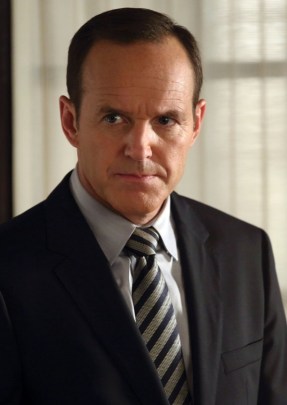
As I reflected upon my great attachment to this fictional character that drove my binge-watching so much video-on-demand, it occurred to me that he was very similar to another figure that I still harbor a great affection for: Captain Jean-Luc Picard of Star Trek The Next Generation. Captain Picard also leads a diverse and sometimes hot-headed crew that flies around confronting danger and strange, alien technology at great personal peril to protect the innocents in the universe. The Star Trek captain is also the cool-headed strategist who knows it’s a trap, but knows they have to go in, anyways, to rescue their team member. He is the backbone of morality that guides the crew. Every Next Generation fan knows that if Picard can make it out alive, he can fix things. We have faith in him. Just like Picard is a Captain in Starfleet, Coulson is a Director in S.H.I.E.L.D., a secret but trustworthy organization full of exceptional individuals doing spectacular work.
This faith in the goodness of this leader, and of the organization he leads, is vital to our enjoyment of the show. At the end of STTNG season one, there is a conspiracy that goes to the very heart of Starfleet. Admirals have been taken over by mind-control aliens and only Picard possesses the smarts and integrity to root out this corruption and end it. Similarly, in season one of Marvel’s Agents, the secret organization of S.H.I.E.L.D. itself is infiltrated by an even-more-secret organization called Hydra and Coulson’s team is cut off from the larger family of support they once had. Yet Coulson and his team, save for a single turncoat, remain morally pure. We don’t ever stop rooting for them.
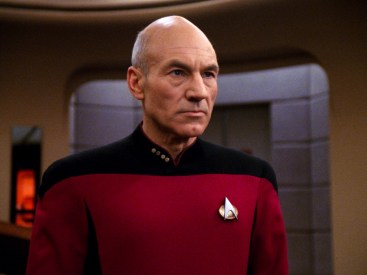
Both leading men are co-opted by alien biology in the course of the show. Coulson is injected with alien blood to save his life. Jean-Luc is kidnapped by Borg and his body is colonized by their nanobots. In both cases, the fans at home are threatened by the thought of a world in which their great, moral leader can no longer be trusted to provide wise advice and strong direction to a world in chaos and danger.
As I examined these characters’ function in both series, and my deep emotional attachment to both figures, it occurred to me that Marvel’s Agents of S.H.I.E.L.D. is a product of ABC and their “Family” programming and that this view of the world in which the all-powerful force in charge is actually a really swell guy keeping us all safe – in fact, a white, straight, male, middle-aged American really swell guy – probably reflects a lot on current attitudes in the United States and in myself. Picard wears a Starfleet uniform that was very 90s in its form-fitting style. Coulson wears what amounts to a uniform in his perpetual black suit and tie. There is something about this constancy that is reassuring. Paired with a controlled (somewhat repressed) emotional expression, this makes both men fit well into the Midwestern or WASPY tradition of masculinity. (Coulson is, in fact, called out as being from Wisconsin, though Jean-Luc, ever the 90s man, grew up on a winery in France.)
This traditional masculinity and white, straight, middle-agedness strikes one even more as a deliberate choice by the producers when one considers the team of special agents under Phil Coulson’s direction. By the end of season one, Marvel’s Agents of S.H.I.E.L.D. even has two black men on their dozen-strong team AT THE SAME TIME! The second in command on Coulson’s invisible jumbo jet is an Asian woman (who, by the way, doesn’t walk around half-naked talking in a soothing voice). Another light brownish leading lady is eventually revealed to be part Chinese.
The official head of S.H.I.E.L.D., Nick Fury, is an African American, and has been established as such in the Marvel universe as far back as comic books released in the 1970s. But ABC chose not to do a show about Nick Fury leading a team. Is it because having a black man in charge would not be assuring to the majority of the middle class Americans that ABC producers are seeking to capture for their advertising dollars? I think it likely. Since Samuel L. Jackson in particular was cast as Nick Fury in the current Marvel universe, I think it safe to say that he would not be that reassuring. He’s no Avery Brooks (Captain Benjamin Sisko on Deep space Nine).
I don’t point out this WASP-y centrism of either show to disparage them as bad shows. I love both shows, both leading characters, and think they are both progressive in several ways. I just think it wise for us WASPy viewers at home to be aware that the entire universe of these shows has been created in our own image. But it as sci-fi has taught us, it is only one of many co-existing alternate universes.
Also, Agent May is Spock.

 L.A. Kuemmel