
Not that mermaids haven’t been a thing at any point in the past 200 years. Hans Christian Andersen famously wrote about them in 1836 but didn’t invent them. One appears in the Kalevala, the Finnish national epic, first published in 1835 but based on earlier folk tales. I was laid up after surgery last year and decided to read the Kalevala for a book I was outlining set in medieval Finland. There is a young woman who turns into a vengeful mermaid and it so captured my imagination that I put down my outline and started another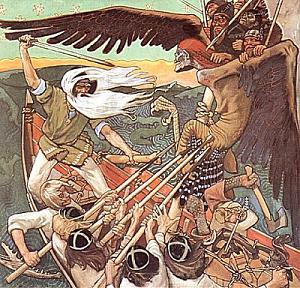 outline centered on this young woman/mermaid.
I had my A plot completed when I decided to round out my research with an online search for “Finnish mermaid” which quickly revealed that mermaids are not a thing of the past. They experienced a revival last year thanks to a woman who gives classes at public pools in Finland on “how to be a mermaid.” Participants both female and male (bless you, Finland!) wear fabric and plastic tails with a big fin on the end and learn to swim with their mermaid tail on. Further searches revealed that this trend has spread from Finland to Britain to Los Angeles.
I also read a great short story in the speculative fiction collection New Suns called “The Freedom of the Shifting Sea” by Jaymee Goh. It takes place in Malaysia and has a very different explanation on what kind of creature the mermaid is, but still paints her as a female avenger.
I feel this legend is ripe for the retelling. I read the Andersen story as a child and have always thought of mermaids as beautiful, gentle, loving, and forgiving. Andersen’s protagonist is very morally pure. As an adult I have reflected upon the popular Greek myth of sirens, known for luring sailors to their death upon the rocks, and realized that this is essentially the same creature. It’s just that Andersen paints them as delicate fairies and many other versions paint them as honeytraps. Both versions are typical sexist oversimplifications that assume these creatures aren’t capable of the same complexities of a human woman.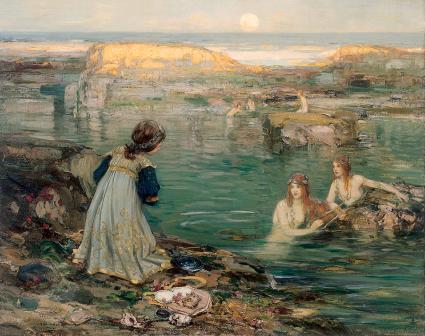
Nina at fairychamber.com tells us that in Finnish folklore there were several different names for what we would term in English only as a “mermaid,” depending on if they were salt water, fresh water, or mothers instead of maidens. All of these versions might lure someone (ahem: heterosexual men) into the water where they could easily drown. These various mermaids did not have fish tails in Finnish mythology, but instead wore “dresses made of sea foam.” In either imagining, these sea maidens don’t seem to get much coverage of their privates. I wonder who came up with that description (ahem: heterosexual men).
In my manuscript I’m having them wear clothes most of the time. I figure they live in a society, just like humans, so they’d have a taste for personal decoration. Humans have been decorating themselves with paint and shells for at least 100,000 years. Maybe mermaids wouldn’t wear the same sort of clothes humans wear but they would wear something. They would try to impress each other and try on new identities just like humans do with their clothing.

 L.A. Kuemmel