I have completed major rewrites on the first 50 pages of the novel! I have dispersed it amongst some valued readers and have received a lot of positive feedback (i.e. “This draft is better than the last one.”) I did get a request to bring back some of the flashbacks that I cut. Or perhaps it would be more of a prologue, as it would be one flashback at the beginning which isn’t really a flashback if you haven’t established any other timelines. I’m torn about the suggestion. I also received a note that “It’s easier to follow without the jumping around in time.” I guess my question is “Can an 11-year-old follow it, and if so, would she like it enough to read more?” I bet she could. So I guess we’ll brainstorm a prologue.
The other thing I’m noticing about the feedback notes is that people miss the meticulous world-building. All of my readers so far have been adults, most of whom do not read a lot of YA fiction (though some are fantasy adventure readers). I am kind of proud to have written something so spare and plot-driven that it annoys middle-aged people. YESSSSS!!! I focused on doing that and seem to have been successful. I am good for something after all.
I have also received some suggestions for how I can world-build by showing and not telling, which is the best of both sides of the coin (lush imaginary details, but also staying action-based).
I love lush, imaginary details. Fictionalizing without getting in trouble for lying. When I was twelve at summer camp, I went to a leather-working class one day and made myself a bookmark. On it I stamped out the letters “I ❤ FICTION.” Then, because they ridiculously did not have a unicorn stencil (what were they thinking?), I used the horse stencil and a line stencil to stamp my own unicorn on the bookmark. I think maybe what I should have written was “I ❤ FANTASY,” but I was not yet old enough to make that distinction. If it was a lie that wasn’t trying to be believed, I liked it. I think the line between fiction and fantasy is pretty fuzzy still today (because bodice-rippers obey the laws of physics, does that make them plausible?), but I understand the colloquial use of the terms.
Word count is approaching the coveted 90,000 mark! It’s at 91,000+. The last half of the book could use some gutting. I know there is some lazy language in it. Some puttering along in a not very urgent or direct phrasing kind of way where I am sure to qualify all of my adjectives so you don’t get the idea anything too extreme or upsetting is going on. You know, comfortable little kiddie korner stuff that makes you feel all quaint and cozy like you’re reading The Hobbit. I do love The Hobbit. But I don’t know that any book with that slow a pace would interest many YA agents these days. Unless, you know, I already had a best-selling adult fantasy trilogy. Luckily, along with my meticulously puttering self, I also have a belligerent, short attention span self that I can summon up to edit with. She gets half way though a paragraph and yells “BOR-ING!” and deletes everything she’s just read and doesn’t look back. (Don’t worry, I save my old drafts.)
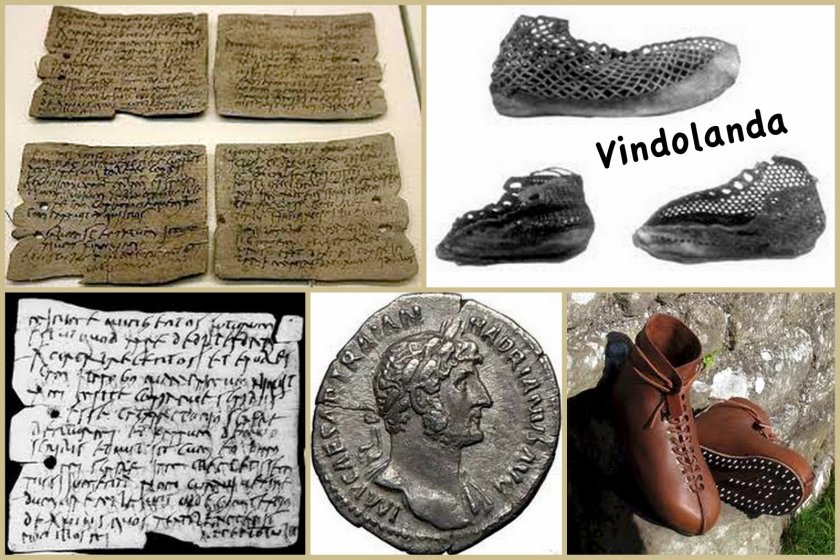
Next week I am taking a trip to England where I am going to visit the ruins of several Roman forts along Hadrian’s Wall. I hope to glean some insights about the political situation I have portrayed in my novel. There is a similarly occupied, remote northern province where the protagonist grows up. The tension between the foreign soldiers and the local townspeople that they live amongst is a constant presence in the first fifty pages. Indeed, the sense of oppression this engenders in the main character is something she takes with her for the rest of the novel. The best Roman archaeological find in England (and perhaps anywhere outside of Italy) is at Vindolanda. It is most remarkable for the Vindolanda tablets. They contain personal, hand-written letters sent from across the Roman empire to Britain and reveal intimate details like invitations to birthdays, weddings, and even a mother saying she is sending her son fresh underpants. (I am not making that up.) The Romans may have slaughtered lots of Britons and displaced local culture, but they were people, too. It is this complex reality – both the colossal injustice and the precious foibles the occupation brought with it – that I seek to comprehend and capture in my own writing.
Wish me luck on my travels.
 L.A. Kuemmel